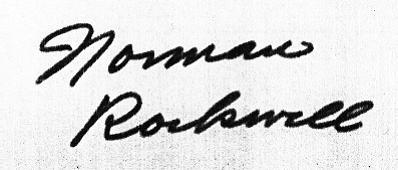
and
Southbridge Evening News Article - March 5, 2004
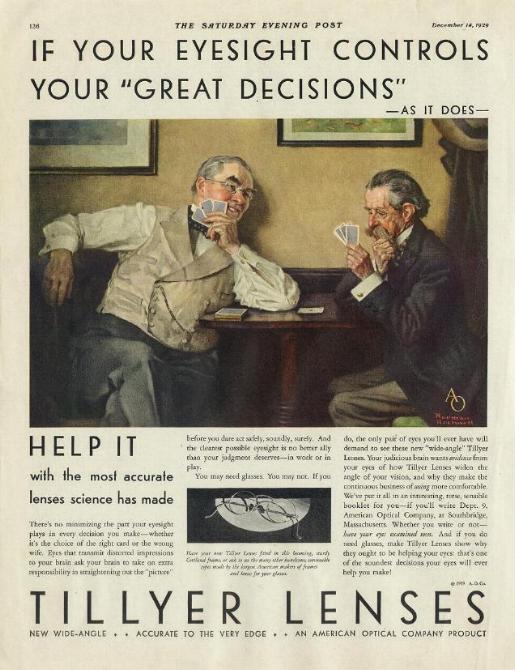
Norman Rockwell paintings
commissioned by AO still missing
By Cindy Sebrell
News Staff Writer
More than 20 years ago, a sign displayed at the American
Optical Museum informed viewers that in 1929 the company had
commissioned Norman Rockwell to do six original paintings. But
the sign also stated that four of the paintings, which had been
used for advertisements in the Saturday Evening Post, were lost
in a fire at Rockwell’s Vermont studio in the 1940s.
But were they? Two of the supposedly lost paintings later showed
up in private collections, making Dick Whitney, the AO museum’s
current curator, suspect that the other two were not destroyed
either. Are they out there, somewhere?
“I don’t think the originals burned in a fire,” Whitney said. “Some have speculated that they were hidden in the clock tower. Some people have told me the paintings are still here in the area. Someday they might show up. It is really quite a mystery that has become a local legend.” The story is full of twists and turns. Just how the four paintings that are known to still exist, which were at one time owned by AO, were dispersed and sold is an item of contention. But there is little doubt that the two were sold at auction in 1998 and the other two are owned by Pfizer, one of the world’s largest drug companies, formerly known as Lambert Pharmacal, which bought out portions of AO in 1967.
The two Pfizer paintings are currently on exhibition at the
Rockwell Museum in Stockbridge. At the same time, Whitney has
just finished installing an exhibition in the Jacob Edwards
Library in Southbridge, which includes copies of all six
original paintings, along with some other important AO
memorabilia and photographs. The exhibition will remain open for
the month of March.
Where is the Girl in the Red Hat?
One of the most lovely paintings that seems to have been “lost” depicts a fashionable young woman wearing round eyeglasses and a chic red cloche hat. She is driving a speedy-looking 1920s car and is jauntily looking out the window at the viewer. “The woman with a red hat is most allusive,” Whitney said. “I have heard rumors that someone knows where the painting is, and I am looking into it. But I have never seen any real evidence of the paintings whereabouts.” Although it may be hard to imagine that the location of a painting as valuable as a Rockwell could be unknown, the problem is not uncommon in the world of art. Provenance, as a painting’s ownership lineage is called, is often filled with mystery and intrigue. Art magazines dedicate many pages to the debate over the provenance of “Nazi art,” the many masterpieces that were taken from Jews and other victims during the second World War but are now in museums and private collections throughout the world. It is speculated that stolen artworks quietly end up in private collections after a “cooling off” period. Even directors of large museums, including Phillipe de Montebello at the Metropolitan Museum of Art, have acknowledged that the provenance of some of that museum’s artworks is unclear. Sometimes the missing links in a paintings provenance are due more to carelessness than nefarious activities. Like antiques, art often gets passed on, sold, and transferred without documentation.
For that reason, Rockwell Museum curator Linda Szekely Pero
declined to say that the “Girl in the Red Cloche Hat” and
another painting, depicting a be-spectacled young boy reading a
book, is “missing.”
“They are not missing, as such. We just don’t know where they
are,” she said. “Whoever owns them has never contacted the
museum or made it known in a public way. Saying they are missing
implies that they were taken. There are many Rockwells that are
out there that we don’t have ownership information about.”
In that sense, the mystery surrounding the location of the two
paintings is not unusual. Rockwell completed about 4,000 works
in his lifetime, and the museum dedicated to his life and work
owns only about 600 of them. Other major collections are owned
by the Boy Scouts of America and the National Museum of American
Illustration, in Newport, RI., but many are owned by
individuals.
At least one reason why Rockwells were so easily dispersed is
because the art world at large did not much appreciate the
illustrator-for-hire that Rockwell was. His works were viewed as
less valuable because they were commissioned and mass-produced
for advertisement. And Rockwell himself helped to make the
provenance of his work untraceable.
“He often gave things away and sold his work,” Pero said. “His
paintings were not collected by museums. It was not like every
museum of American art felt they needed to include a Rockwell in
their collection.”
No matter the complexities of provenance, Whitney disagrees. Since they were reported to be destroyed in a fire, and then at least two of the were discovered intact, he considers the pieces missing. Even the story of the fire sounds suspicious to him. “They were commissioned by AO and they were brought here at one point. I just don’t know where they have gone from there,” he said. “Somehow they ended up in someone’s collection. Warner Lambert took them. They were taken out of Southbridge where they belong.”
The AO Museum
The American Optical Museum was founded in 1982 to mark the
150th anniversary of the venerable old company. Although it once
was housed in the main building, the museum no longer has a
permanent exhibition space. Its collection includes old
spectacles, memorabilia, blue prints, photographic negatives,
and other items of interest in the field of optics. Whitney has
been quietly adding to the collection, which has been in storage
since the main plant was torn down to make room for the
Southbridge Hotel and Conference Center. “It is just a matter of
overseeing it,” he said. “I am looking after the best interest
of the whole collection.” Although the museum no longer owns its
Rockwells, it does still possess original paintings by a
lesser-known artist named Stoops. The Stoops were also used for
advertisements. One is on display at the library exhibition.
Original Herman Stoops of four old scenes of spectacles and
watch repair ads have all four Hanging now shows a doctors
office and a man being
“It is quite a nice picture,”It is to AO’s credit that they
chose Rockwell so early on, according to Whitney. “They
commissioned Rockwell when he was relatively unknown,” he said.
“But they are beautiful paintings.”
Where to See Them
“The Picture of Health: Rockwell Paintings from the Pfizer Collection” is on view at the Rockwell Museum, in Stockbridge, Mass., through May 31. In addition to the two AO paintings, the exhibition features 9 other original works Rockwell completed for the Upjohn Company and Lambert Pharmacal. The medical-related paintings are cherished by Rockwell fans because they depict doctors as compassionate and friendly. Of most famous on display are paintings of a doctor examining a young girl’s doll and of a young couple weighing their newborn baby.“This is one of the most significant corporate collections of Rockwell art,” said Laurie Norton Moffatt, director of the Norman Rockwell Museum in a prepared statement. “They provide a window into 20th-century American health care and pharmaceutical practices. During an era when storytelling art was sought for advertisements, Norman Rockwell immortalized the family doctor for the American public.”
“Through his use of everyday scenes, Rockwell shared the hopefulness and idealism that characterized his view of life,” Pero said. “He depicts such familiar situations that we may not immediately notice the aesthetic qualities of composition, detail, and color and tonal harmonies that elevate these advertising illustrations to works of art. They transcend their commercial origins.”Right now, there is no money to back the AO Museum, but Whitney is working to secure a small grant and donations for displays. Someday, he hopes to find a permanent home for the collection. “Opening a facility sounds nice, but it takes money, volunteers, planning,” he said. “It will not happen overnight"
For that reason, he has installed the current exhibition at the
Jacob Edwards Library. The exhibition is open during library
hours. For now, Whitney maintains a web site and fields queries
from specialists of spectacle frames and other antiques
collectors. He is also working to plan an AO employee reunion in
the fall. The last reunion, which he helped organize, was in May
2003. More than 500 people attended.
Whitney is hoping someone in Southbridge will provide some clues
to the location of the boy reading a book and the fashionable
girl in the red cloche hat.“Where is she now?” Whitney said.
“There are a lot of people who would like to know.” Norman
Rockwell Museum is open daily from 10 a.m. to 4 p.m. Admission
is $12 for adults, $7 for students, and free for visitors 18 and
under. Rockwell’s original Stockbridge studio, located on the
Museum grounds, is open May through October.
C.L. Sebrell is a freelance arts writer and editor. She may be reached at csebrell@hotmail.com.
Click here
for the latest on the Norman Rockwell paintings

The statement above (from the AO Museum in 1982) claiming
that the 4 paintings burned in a fire at his home is not true.
Mike Leck's correspondence he had with Norman Rockwell in 1972!!!
I
Norman
Rockwell
Magazine Covers
(Tim Tillyer Web Page of Magazine Illustrations)