AO Scientific Instruments History
The AO Lensometer
Note "Lensometer" was an AO Trademark
name

AO Promotional photo (~1920) for the first marketed AO
Lensometer which was first sold in 1921;
the principal by which we still measure lenses today. In 1916,
AO began using the Lensometer in its factory/ branches.
In
1917,
it line of Centex lenses was introduced
which were designed by effective power (now the Industry
Standard).
Early "AO
Lensometer" related measuring devices
This website page shows the lineage of the AO Lensometer over
time, an instrument which
is still one of the most important devices in the Ophtlamic
Industry today.

Dr.
Tillyer
in the image above from a 1918 Booklet on the Lensometer
Download this first booklet (4mb pdf)
Download
the
AO 1938 Booklet about this model, and the complete
background
of
the
AO Lensometer up until then.
It was written by Dr. Estelle Glancy

1914 AO Lensometer which predated the first device sold in 1921

Early Lensometer (Serial #002) - 1921
AO Optical Heritage Museum Collection

AO "Wellsworth"
Lensometer ad from Febrary, 1922 showing Doc
Tillyer measuring a lens
A look at the early development/ timeline of AO's Lensometer
(Left image below)


Model 603 from 1938 - The Junior AO Lensometer
(at right above)
Information on WWII and AO Lensometers used in the war (bottom link)


AO Lensometer Catalogues from 1947 (L)- list price $310 and 1958 (R)- list price $435

1952
Instructions
/ Manual & Maintenance Booklet
Download pdf (10mb)

1956
AO
Electronic Focusing Lensometer by Whitney/Haynes/Gunter


AO Lensometer Catalogue - 1959 (above)

A simple diagram of the principal used in the AO Lensometer to
measure tranmission dioptric power of a spectacle lens.
This is from Don
Whitney's
1981 Optics training slides that he compiled for a course
given at that time.


1977 Brochures of two popular AO Lensometers
Download AO 12603 Lensometer Brochure
Download AO 12620 Lensometer Brochure


AO Lensometer Blueprint - 1971
Specialized AO Lensometers
The one shown below was used to develop the AO Tillyer
Masterpiece lens series; Ina Pasay Dawson is shown here using
this device in the 1970's.
This device was built a couple 1-2 decades before. It
permitted one to measure off-axis tranmission power of the
lens,
to determine the optical errors the eye would see as the eye
rotates away from optical center.
This device among the many AO Lensometeres from the Optical Heritage
Museum collection.


Download complete AO Masterpiece
Lens brochure from 1968 (excerpts above)
The device below (1977) used a modified in AO 12603 Lensometer to accomplish the same thing as the "Masterpiece Lensometer" above. It permitted one to rotate a lens (using set center of rotation distances) to similuate the eye motion away from optical center. With this rotation, power errors and prism retulted. To measure these errors, the telescope was rotated as shown to determine whether the design / fabrication met AO and Industry Standards at that time. ANSI Z80.1 -1972 required lenses to meet specific off-axis tolerances for power errors.


Download the AO SLP that I
wrote in 1979 on how to use
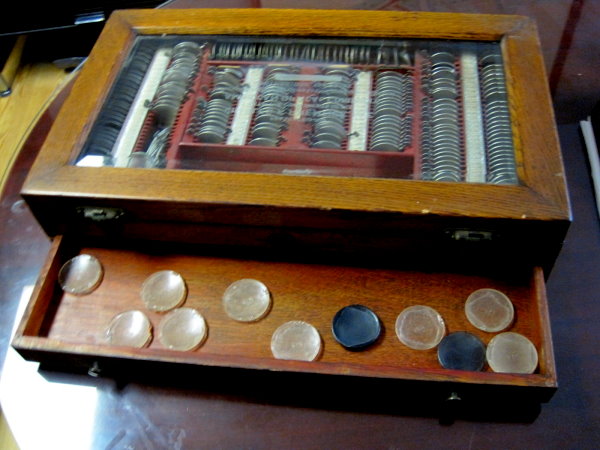
AO Lensometer Calibration Lenses

This is the AO primary true-power lens set Calibrated by Doc
Tillyer when he worked at the National Bureau of Standards prior
to joining AO.
Each lens was measured for its refractive index (a sliver taken
from the edge). The curves were measured and then the resulting
power calculate.
Two lenses were re-certified in 1977 and had not changed. It is
this set by which all AO Lensometers were originally calibrated.
The set (and another secondary set) is part of the Optical Heritage Museum collection.

Blair Wong (Ben Franklin Institute
of Technology - Opticianry Dept Chair & Exec Director
of MA
Opticians Assocation
and Diane Matuck (Board of MA Opticians Assocation) examine the
AO NBS set from 1916.

1977 AO Lensometer calibration lens set ad above and two below
today.


This AO Lensometer was modified ~ 1987 and used to check the
reflected image of Progressive Lens mold engravings;
it was not used for Transmission measurements, but was a clever
and accurate way to examine engraving quality.

May
2009
Lensometer Display (courtesy of the Optical Heritage Museum)
at the Southbridge Hotel and Conference Center