Whitney Web Page - Our Home
Town
Southbridge, Massachusetts
Southbridge - Then and Now
The Manning Leonard Home
25 Elm Street
and
Now Home of the Southbridge Evening
News
To Contact The SENew, email:
southbridge@stonebridgepress.com
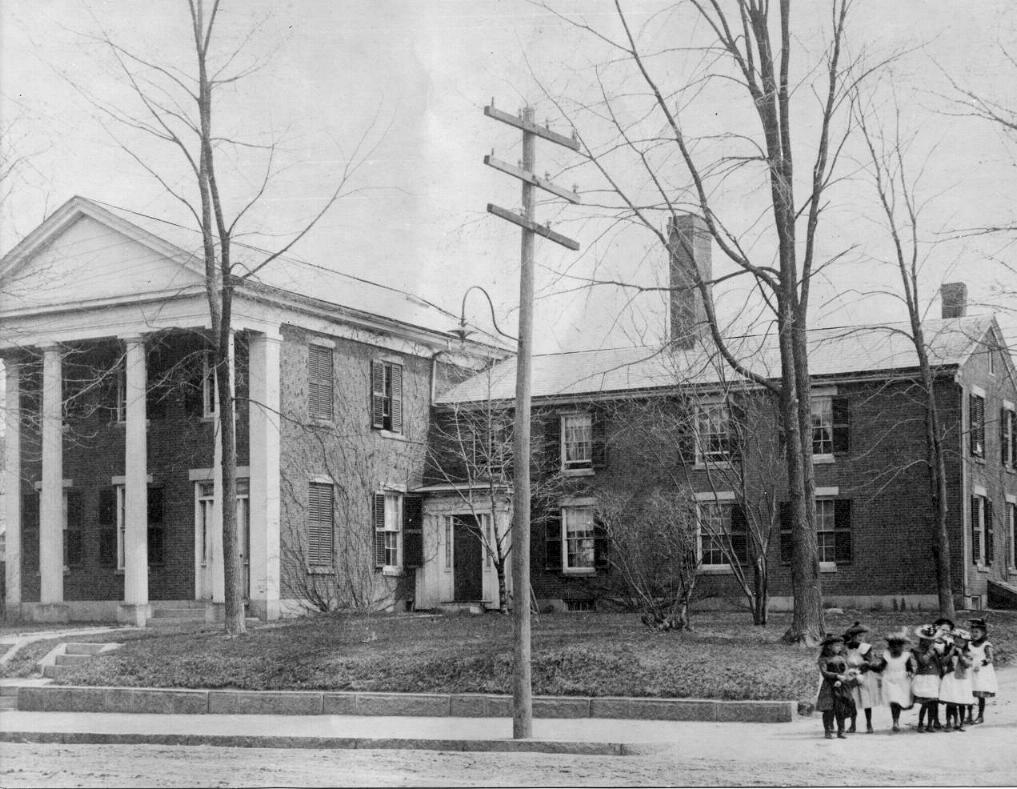
Date unknown -
Courtesy of the Jacob Edwards Library and Southbridge Historical Society
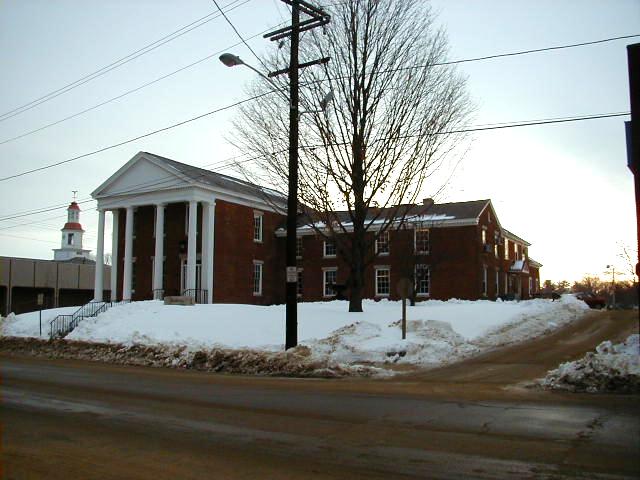
Early morning view of the News Building (Feb 2001)
Taken from the Southbridge News, Saturday, June 11, 1938, entitled
"Prominent Resident Liked Southbridge On Visit So He Moved Here"
"...Manning Leonard, prominent citizen and industrialist, who lived
in the Elm Street house buit by Bela Tiffany and now occupied by
the Southbridge News. Tiffany, incidentialy lends a romantic touch
to the picture of the time. He was a wealthy New Yorker who first
came to Southbridge riding magnificently in a coach and four in search
of health and, caught by the charm of the town, remained to become a leading
citizen. According to tradition his home was specifically designed
to fit his valuable carpets of which he was very proud."
To Learn more about Manning Leonard, see extract from Levi Chase 1889
document below. Click here for the complete
Levi Chase article. Shown below it the Manning Leonard portrait
which is on display at the Jacob Edwards
Library.

The Manning Leonard Biography Extracted from :
S O U T H B R I D G E
By
Levi B. Chase
Extracted from
“The History of Worcester County, Massachusetts”
by Hurd, 1889 Vol. 2
BIOGRAPHICAL
_________________
MANNING LEONARD
Manning Leonard was born in Sturbridge, June 1, 1814; died in Southbridge,
July 31, 1885. Among those interested in the history of Worcester
County Manning Leonard was one well deserving special mention in these
memoirs, both because of his connection with those who had no little part
in shaping the history of the towns of Sturbridge and Southbridge, and
because of his own honorable record as a citizen.
His mother, Sally Fiske, daughter of Henry, was a grandchild of both
Henry and Daniel Fiske, the first white settlers in the town, who located
on what is now known as “Fiske Hill” in 1731, and from one of whose descendants
Fiskedale in Sturbridge was named.
His father, Rev. Zenas Lockwood Leonard, fifth in descent from Solomon,
who landed at Duxbury in 1636, was born at Bridgewater 1773; graduated
at Brown University in 1794 and came to Sturbridge as a Baptist minister
in 1796. During his long pastorate of thirty-six years he had a more
than ordinary interest and influence in the affairs of the community.
Though on a small salary, never exceeding two hundred dollars, he maintained
a hospitable home, gave his children a good education (sending his eldest
son through Brown University), kept free from debt and gave his family
an honorable position in the community. In all household affairs
he was ably aided by his wife, who was a model of quiet efficiency.
Of their seven children, Manning was the fifth, having a brother and
two sisters older and a brother and sister younger than himself.
Reared in a home of order, thrift and industry, he naturally developed
such a degree of self-reliance, diligence and self-respect as gave early
promise of sure and honorable success in life. Generously determining
to forego the advantages of a college education, he defrayed his own expenses
during a course in English and the mathematics at Amherst Academy, under
the tuition of Rev. Simeon Colton, D. D., taught school a term at South
Amherst and then, to school himself for business life, became a clerk in
the dry-goods house of Tiffany, Anderson & Co., of New York City.
After three years spent in an earnest endeavor to master every detail of
the business, he went West in 1835, the year of his majority, and in 1838,
joining with George M. Phelps, a young man also from Worcester County,
established himself in business in Madison, Indiana. He prospered.
In 1840 he married Mary F., daughter of Hon. Ebenezer Davis Ammidown of
Southbridge, Mass., than whom no one had greater part in making Southbridge
the beautiful town it is, or contributed more to its material advancement.
In 1844 he returned to Southbridge, and first, with his father-in-law,
and later with Chester A. Dresser, was for twenty years engaged in the
cotton manufacturing business at what is known as the Central Mills.
On account of failing health he retired from active business in 1863.
Nevertheless, he did not subside into listlessness and idleness, but maintained
an active interest in public affairs; was on the Board of Selectmen during
the early years of the war; was a representative in the State Legislature,
and for many years a member of the Southbridge Public Library Committee;
a prime mover in the establishment of the Southbridge Savings Bank in 1848,
he was secretary of that corporation until his death, and also was a director
in the National Bank.
He was an active and consistent member of the Congregational Church
for more than fifty years, and generous in his support of the great work
of home and foreign missions as well as various undenominational charities.
For many years, more or less of an invalid, he traveled much for health
as well as for business - twice visiting Europe, once California and many
times going to the great prairie States. Yielding to a complication
of diseases, he died at Southbridge July 31, 1885, having completed his
seventy-first year two months before.
In early life ever striving to fit himself for the task of the morrow,
while faithfully fulfilling the duties of the day, he won promotion by
merit rather than sought it by favor.
In middle life a man of reserve power, whose sagacity and foresight
gave him success where others failed, and being eminently a just man, he
was made the recipient of many public as well as many private trusts.
In maturer years more conservative and cautious, yet never a captious
obstructionist, his counsels were the more valuable because his course
had been always consistent - ever securing not the applause of the many,
but the approval of the best; he had been not a partisan, but a patriot.
Return to Southbridge Then and
Now
AO Then and Now
Whitney Southbridge Page
Return to Whitney Home Page