(His recollections of organizing the AO Museum Collection in 1983)
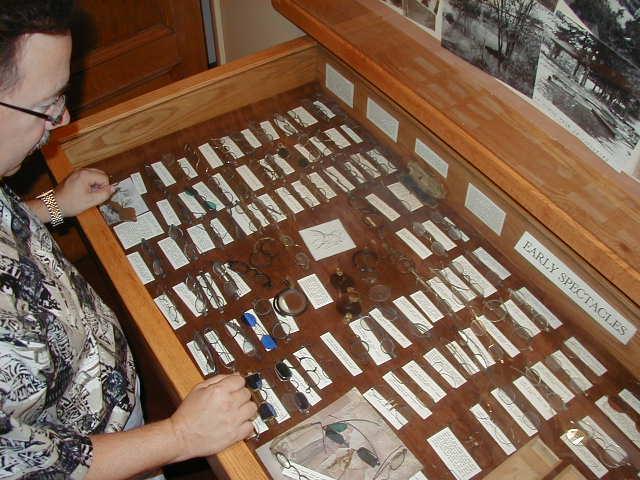
The photos (by Dick Whitney) on this page are of John
Young in the
AO Museum, and were taken in August of 1999. This was
prior to the DOD
project, and are among the many photos that I archived of
the AO Museum
as it was in the Main Plant Facility. John has been a long
time friend
since we both worked together at AO in the late 1970s.
Thanks to Zeiss, the Museum reopened in 2013 and is
presently located at 12 Crane St, Southbridge.
http://www.opticalheritiagemuseum.com
John passed away in June of 2017, and will be greatly
missed. Read his recollection of the start of the Museum
which would not exist today without his perseverance to
establish it back in 1983.
John Young wrote the following about the Museum:
The
roots of American Optical go back to 1833, as most
people in the area are
now aware.This
means that American
Optical has not only been in operation for over 150
years, but has also
had 150 years to accumulate all kinds of stuff.Everytime
company management would move the treasurer’s office or
the gold assaying
area, or just plain out grew the current space, the old
‘walk-in safe’
in that area was just abandoned and sat there through
time filled with
stuff.That stuff
eventually became
old and valuable.
The
museum got its start when a group of us in Marketing
began to talk about
how to take advantage of the 150th birthday of American
Optical.There
were, of course, several projects that were completed
which would advertise
this to our customers but something did happen that
started us down another
road.Someone said
that they had
heard that there was a vast storehouse of old frames
that we might want
to give away to our customers during the celebration.This
celebration had just started into the planning stage for
the Optical Laboratories
Association Convention, which as I recall was about
seven or eight months
away.That comment
struck several
of us the wrong way and didn’t get very far before
someone suggested that
a steering committee be formed to look at all the
possibilities for our
customers, our employees and our town.
With
a little digging and some questions to the folks who had
been around for
a while in the company, it became apparent that there
was, indeed, a collection
of antique eyewear scattered around the buildings,
who-knows-where!At
the
first steering committee meeting, there had been
suggestions of a parade
and an open house.I
had suggested
the idea of using the antique materials in a display of
some sort or a
mini-museum.In
the Army, you’re
taught never to volunteer and I suppose that goes for
ideas as well, although
I do seem to recall others with a similar concept at
that steering committee
meeting.Anyway, I
was never in
the Army and thus, I had the project assigned to me to
chair its creation.Whoa!Where
to
begin?
That
is actually when the real fun began.I
remember a group of novice volunteers charging excitedly
around the main
plant after hours with flashlights looking for what we
had heard was the
true “piece-de-resistance.”This
was reported to be one or more frames that had been
individually cast and
filled with precious jewels; we felt like we might have
been in search
of King Solomon’s treasures.The
members of that volunteer team were Marge Breen, Dave
Butler, Priscilla
Butler, Cris Waldron, Brad Noble, Addi Perry, John
Mikoljaczak, Sandy Neiduski,
Connie Borey, Sandy Furioso, Milt Freeman and later on
even Ruth Wells
herself joined in the project of restoration of frames
we had uncovered.
In
the dark, we felt like plunderers of the past as we
opened the main plant
safe in the treasurer’s office, a move which would
later, in day light
hours, be lightly frowned upon by management.Thankfully,
we had Dave Butler with us and he was the Director of
Plant Security at
the time.He may
have taken a bit
more ‘heat’ for the endeavor but, if he did, he never
admitted it to us.The
five
jeweled frames that had been reportedly cast for the
Madame Schaparielli
signature design series were elusive.Then
while looking in a small box of what appeared to be a
wrapped cleaning
rag, we found something that would give the whole museum
venture life and
push us forward in our endeavor.
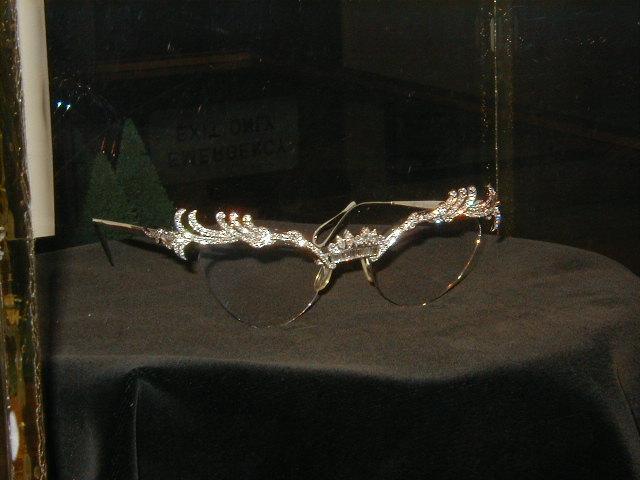
As
we unwrapped the cloth in that dark, dank safe, we could
begin to see the
sparkling of a brilliant frame of iridium platinum
containing what we would
discover was 201 diamonds with a weight of 7.5 carats.This
frame became the true leader of what would follow and
what followed was
a committed group of volunteers, working late at night
and weekends after
everyone else had gone home, cleaning and polishing the
old frames and
lenses we had found in our many expeditions through the
main plant.During
these expeditions, we found a total of 4,3000 antique
frames, 2,500 glass
negatives of early Wells’ family photos, AO and
Southbridge people (later
donated to the Southbridge Historical Society); what we
believed to be
the third AO LensometerÒ commercially manufactured
designed by Tillyer,
the Todd/AO reel of the movie Oklahoma, and other
numerous items.All
of
it was exciting, like being a pirate of old, except this
was legal and
for a good cause.
The
Schaparielli frames were originally produced to
introduce the first ‘signature’
series; the first time a ‘signature design’ series had
ever been offered
by anyone for any product.The five
originals were hand cast, then mounted with jewels.These
were then offered to AO’s better practitioner customers
to display in their
windows for a short time.Of
the
five frames, the only frame that was duplicated was the
diamond inlaid
frame and it is the only surviving frame of that
original collection of
five.It had been
reproduced at an
unknown price for someone in England.
One
night while foraging in one of the old vaults, we began
to pull out dusty
packages wrapped in brown butcher paper and tied with
twine.As
we opened these ancient time capsules, it began to
appear that they were
sarcophagus for spectacles; all new! Around
1904 to 1908, American Optical found themselves in two
situations; they
were becoming a global operation, and they were being
copied due to their
success.George
Wells hired a number
of attorneys to watch over the possibility of patent
infringement which
could injure the growth of the company.What
better way than to buy any new frame on the market and
compare it to the
product that the company was producing.So
they did.
What
we found was probably the foremost collection in the
world of what was
called “Pince nez” which, according to Ruth Wells, was
simply French for
‘Pinch Nose’ and pinch they did, we all tried them.the
amazing part of this was that most had no lenses because
they were purchased
before they had been made up as complete spectacles.Some
even had the original tags on them.But
all of them were carefully mounted on dark blue padded,
velveteen, frame
boards.I still remember Ruth Wells
taking on the task of removing each frame, carefully
cleaning each of these,
and each of the many velveteen mounting boards that had
been found.
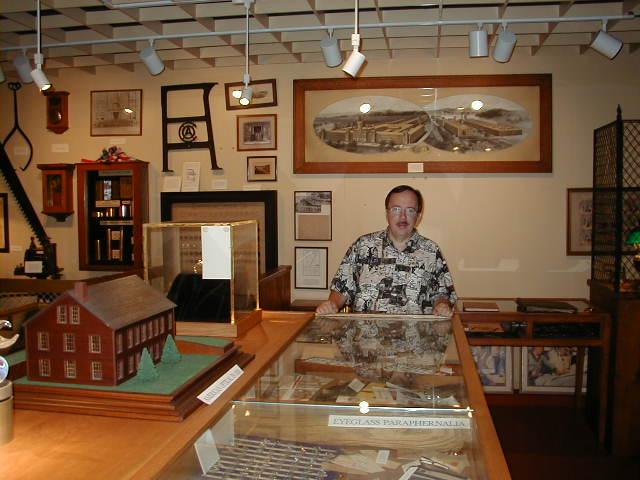
Ruth Wells was always there taking part in her own history, unselfishly working on those dusty old frames, which were part of 114 years of her family’s past.She also gave us the many Wells family photos seen in the current exhibit. While she is no longer with us, we are very fortunate to have the taped interview she and others consented to give to us for our audio history as remembered by those who were there.She is dearly missed by many but she certainly left a legacy of grace for us all to remember.
Meantime,
the material was going to need a place to be displayed
and the room in
the main plant where it now resides was chosen.The
room had been used to display current AO products up to
that point and
what better place to situate the museum; a museum which
had by this time
taken on a life of its own, dragging all of us along
with it.I’m
told by my wife, Patti, that she is officially the first
‘museum widow’
and I’m equally sure that other volunteers were in the
same situation.What
was
most amazing was that there was never even a whisper of
complaint about
the time everyone was putting into this task.We
worked a total of nine months this way.I
can remember carrying a dictating machine everywhere I
traveled.I
was mentally moving from one piece to another along the
cases in the yet
unveiled museum listing the description.Sandy
Neiduski then typed up a total of 16 hours of that
dictation to complete
the small information tag that is found with each item
in the museum.There
was
a very real deadline to meet.That
future opening day couldn’t be changed because a very
large contingent
of Shriners had committed to that date for the gala
parade planned to come
through town, the appropriate State Representatives were
all coming, as
well as the families of the entire workforce; not to
mention the owners
of the corporation.
All
of the work in the museum was completed by the inside
talent that American
Optical had available.These
were
the true craftsmen, some capable of building the
beautiful solid oak cabinetry
seen there.Others
from the AO machine
shop were equally skilled and completely restored the
old flat belt driven
polishing machine which operates in the corner of the
exhibit area.How
many kids would never ever see such a device were it not
for the skilled
hands of those machinists.these
men were as proud of the museum as we were.Even
the American Optical Patent Attorney, Basil Prince, got
involved.In
the creation of the old pine jewelers caged bench, we
needed some authentic
clock
works.Basil, an
antique clock enthusiast,
came to the rescue with a bunch of clocks just perfect
for our needs.So
many reach out to take part and give a little of
themselves during this
effort, that it would be hard to list them all.
Not
all decisions were necessarily good ones, however.A
retired pair of doctors from Springfield had heard about
the efforts at
AO and donated their entire offices to us.Southbridge
Trucking was kind enough to give us a break on cost and
sent out their
crew and tractor trailer to pick up the goods.In
the meantime, I had gotten a call from the Worcester
Science Museum.They
had
one of the doors to a safe from the first building in
the complex at
American Optical to assay and store the gold for the
production of frames.It
had
apparently been replaced or possibly torn out in an
early renovation
when the wooden buildings were covered with brick and
mortar at the turn
of the century or perhaps when the frame operation moved
to the new frame
plant during World War II.
In
any event, here was this huge door and they wanted me to
accept it as their
donation to our little venture.I
did.It was an
unfortunate decision
as the same crew who was moving the material from
Springfield were now
going to have to move this thing as well.It
was indeed a beautiful door, but I had no idea what to
do with it.It
seemed a shame to lose such a piece of memorabilia from
the past, even
though it weighed in at over a ton.Something
like being given an elephant, I suppose.Anyway,
it was moved into storage in the basement of the main
plant where it sat
for years.I’m
sure that there
were many who were looking for good storage space who
cursed me and my
door.
The
material that had been donated by the good doctors was
laboriously cleaned
and repainted in the dank basement of the main plant by
that same relentless
volunteer crew who prepared everything else for that
opening day.It
was then moved into the room opposite the museum exhibit
area.It
remained there for some time as part of the overall
exhibit.Other
items were also donated from quite a wide variety of
people coming from
a number of areas of the country.
Keeping
these ancient pieces in good shape was important and no
one in the group
had ever had curatorial experience.In
several contacts I had made with Crawford Lincoln,
Director of Old Sturbridge
Village, I had found him and his staff always willing to
help.They
advised us of a seminar on this subject coming up right
at the Village.So
off we went to learn what we could about the care of our
growing collection.As
time
went by, I found myself going back to OSV many times to
discuss issues
with their many experts who were always willing to lend
a hand to these
newcomers.
Once
the museum began to take shape, there was a need to get
it appraised for
the insurance company that insured everything else in
the AO complex.This
was
going to take a specialist in the field and I had been
told of such
an individual in New Orleans.He
was an ophthalmologist who collected spectacles and was
also, coincidentally,
the Chief Curator the American Academy of Ophthalmology
Foundation Museum
in San Francisco.As it turned out,
Dr. J. William Rosenthal became a true friend of the
museum and mine as
well.He has
donated a number of
articles to the collection.He and
I also decided that it might be fun to start a group who
had similar interests.the
outcome
was the Optical Heritage Society which meets once a year
to spend
a few days in different areas of the country giving, and
listening to seminars
on anything to do with antique eye apparatus and
spectacles, of course,
were included at the top of the list.It
has grown appreciably over the years since the first
meeting at the American
Optical Museum.Bill
was one of
the first Directors of the AO Museum and is still
interested today in what
becomes of the collection.There
may be better collections in the world but it’s doubtful
that there is
a larger one.
As
the date approached for the opening, things got fairly
hectic.The
final items went in place the evening before the
official opening.The
following
morning before the festivities began, Gene Lewis, then
President
of American Optical, was just coming through the door,
coming in directly
from the airport.He
had just arrived
from a two week business trip to China and the first
thing he wanted to
see was the museum, it was finished.Whew!,
that was close!Gene
had always been
a staunch supporter of the museum from those first
estimates I had submitted,
to when he found out how much it was really
going to cost the company.
The
museum opened on weekends for a while manned by the same
group of volunteers.There
were
even photos and brochures at the Sturbridge Tourist
Center telling
people to come on down to see the museum.This
faded in time but Marge Breen gets the award for
tenacity.She,
situated one floor above the museum, was who everyone
called to see the
exhibit after it had been closed.
The
venture was a learning experience for all of us.I
think now that some of the things learned were actually
the experiences
enjoyed as all of it went together.The
team of people who gave freely of their time became
close friends and had
our own little celebration when it was finally done.Then
there are the people who donated family treasures to the
museum and those
who offered their skills to see the task successfully
completed.Even
those who cheered the project and rooted us on helped
the group immeasurably.For
me
it was the people I got to share it with, the education
in history about
spectacles and a spectacle town’s people that I’ll never
forget.